
Participant ListView VideosScheduleDANFORDS SHUTTLE
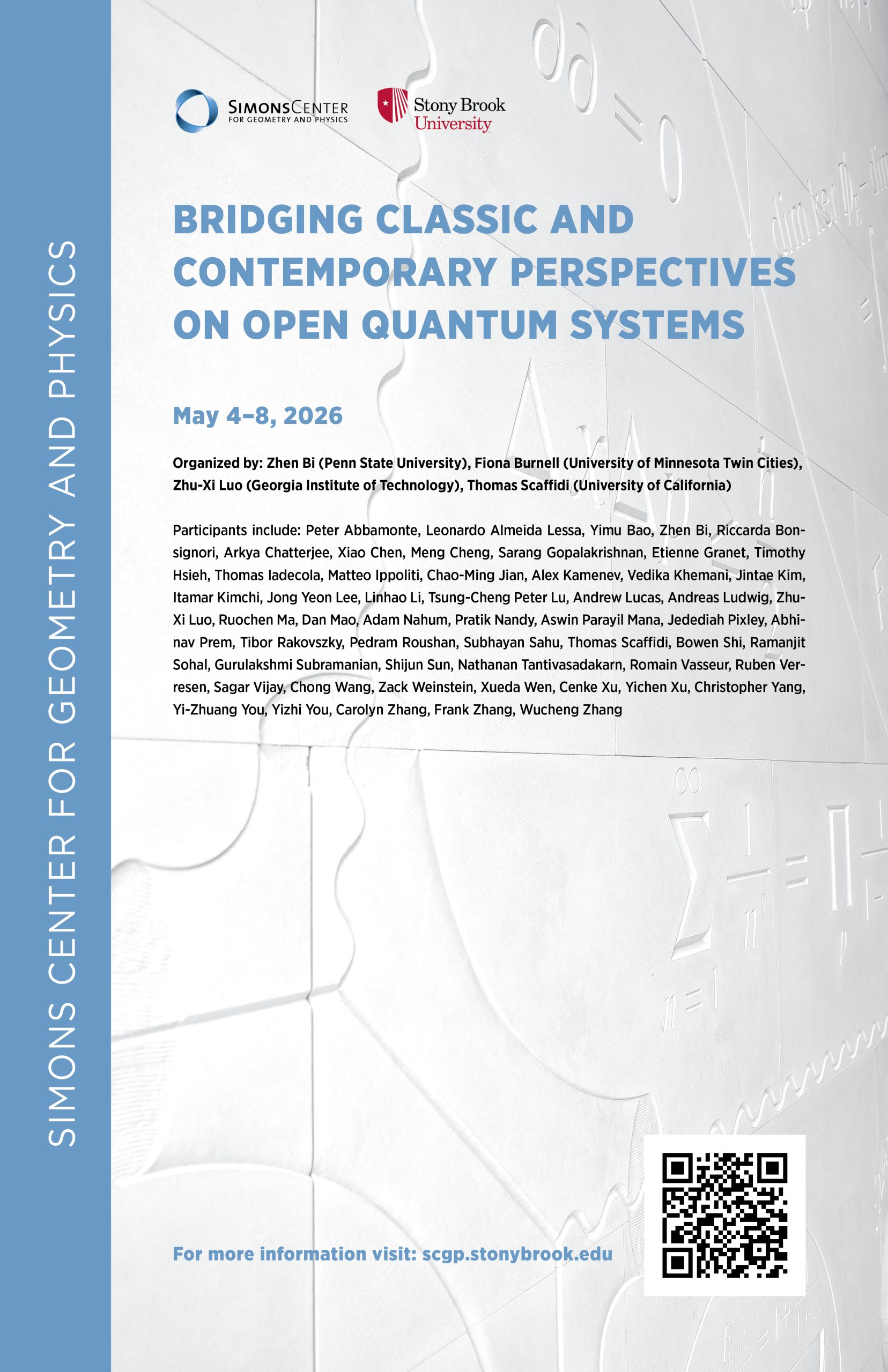
Organized by:
- Zhen Bi, Penn State University
- Fiona Burnell (University of Minnesota Twin Cities)
- Zhu-Xi Luo (Georgia Institute of Technology)
- Thomas Scaffidi (University of California)
Advances in the ability to create and dynamically control quantum many-body systems have catalyzed new and theoretically profound questions about collective quantum phenomena in real-world conditions. For instance, while the classification of quantum phases in thermal equilibrium is relatively mature, only recently has progress been made on the question of how one should define such phases in systems that are simultaneously coupled to an environment and far from thermal equilibrium. Tools for classifying and realizing such phases are still very much under development. In closed quantum systems, entanglement — one of the defining characteristics distinguishing quantum systems from their classical counterparts — can be studied with a variety of well-understood probes. They provide critical insights into phases of matter, revealing underlying structure and universal properties. For open quantum systems, the connection between entanglement and phases of matter is even more fundamental: there are dynamical phase transitions, such as the measurement-induced phase transition, that can only be detected through entanglement measures, which are non-linear in density matrices uniquely sensitive to the quantum nature of mixed states.
In the context of open systems, our tools are much more limited. Developing robust theoretical and computational tools to study entanglement in open systems is therefore essential for advancing our understanding of their phases, and vice versa. A promising avenue for progress lies in leveraging classic results from the study of disordered systems and classical statistical mechanics. In certain limits, open quantum systems exhibit behavior that can be mapped onto these well-established domains. By combining these classical approaches with modern questions inspired by high-precision quantum experiments, we can develop new methodologies to tackle open-system challenges as well as reveal new connections between known classical systems. Our workshop aims to bring together researchers from diverse technical backgrounds—including condensed matter physics, quantum information theory, and statistical mechanics — with a shared interest in open quantum systems. This interdisciplinary gathering will foster valuable cross-pollination of ideas and facilitate the development of the crucial tools needed to address the aforementioned challenges of open quantum systems.
Talk Schedule
| Time | Title | Speaker | Location |
| 8:30am | Breakfast | N/A | SCGP Cafe |
| 9:30am | High-temperature self-correction in Lee-LDPC codes | Andy Lucas | SCGP 102 |
| 10:00am | Non-linear sigma model for the surface code with coherent errors | Yimu Bao | SCGP 102 |
| 10:30am | Coffee Break | N/A | SCGP Cafe |
| 11:00am | A unified framework for locally stable phases | Tim Hsieh | SCGP 102 |
| 11:30am | Theory and experiment of strong-weak SSB | Cenke Xu | SCGP 102 |
| 12:00pm | Lunch | N/A | SCGP Cafe |
| 2:30pm | Non-perturbative monotonicity theorems for RG flow in systems with broken translational symmetry due to measurements | Andreas Ludwig | SCGP 102 |
| 3:00pm | Measurement-induced entanglement in CFTs | Romain Vasseur | SCGP 102 |
| 3:30pm | Tea Time | N/A | SCGP cafe |
| 4:00pm | Entanglement negativity in decohered topological phases | Meng Cheng | SCGP 102 |
| 4:30pm | Higher topological structures in local purifications | Xueda Wen | SCGP 102 |
| Time | Title | Speaker | Location |
| 8:30am | Breakfast | N/A | SCGP Cafe |
| 9:30am | LSM in open quatum system: A spacetime duality view | Yizhi You | SCGP 102 |
| 10:00am | Quantum geometric bounds in ionic and covalent insulators measured with inelastic x-ray scattering | Peter Abbamonte | SCGP 102 |
| 10:30am | Coffee Break | N/A | SCGP Cafe |
| 11:00am | Global topology from local lattice defects | Itamar Kimchi | SCGP 102 |
| 11:30am | Bayesian critical points in classical lattice models | Adam Nahum | SCGP 102 |
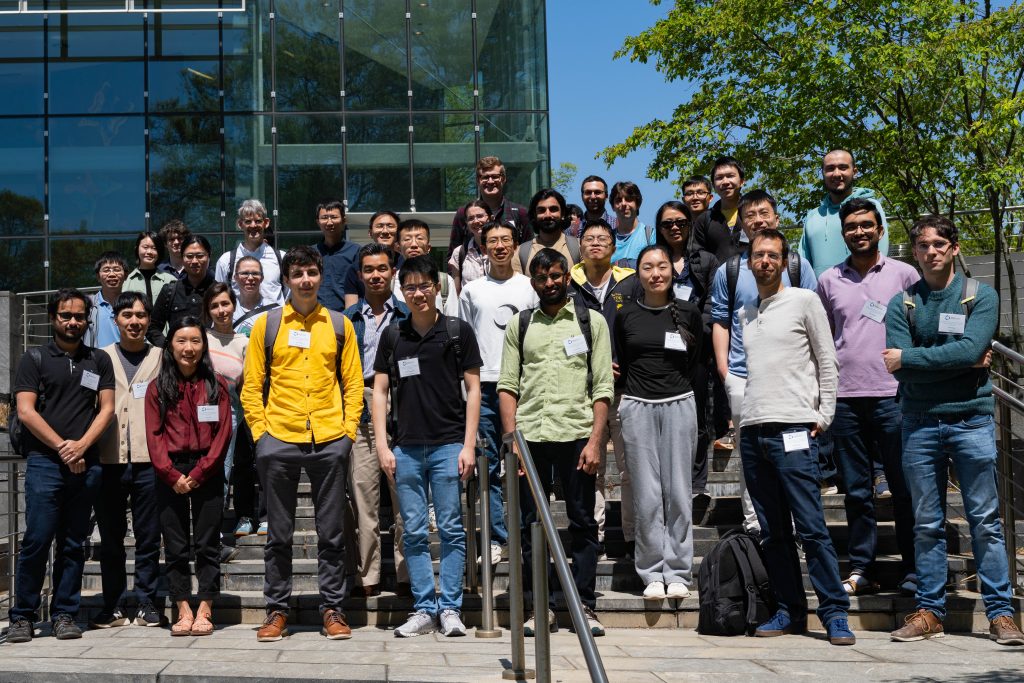
| 12:00pm | Group Photo | N/A | SCGP Lobby |
| 12:10pm | Lunch | N/A | SCGP Cafe |
| 2:30pm | Spectral functions on a quantum computer through system-environment interaction | Etienne Granet | SCGP 102 |
| 3:00pm | Strongly symmetric lindbladians: constraints from LSM anomalies and locality | Carolyn Zhang | SCGP 102 |
| 3:30pm | Tea Time | N/A | SCGP cafe |
| 4:00pm | Error thresholds of toric codes with transversal logical gates | Yichen Xu | SCGP 102 |
| 4:30pm | Coupled-layer construction of quantum product codes | Nat Tantivasadakarn | SCGP 102 |
| Time | Title | Speaker | Location |
| 8:30am | Breakfast | N/A | SCGP Cafe |
| 9:30am | Realizing, using, and decohering S3 topological order | Ruben Verresen | SCGP 102 |
| 10:00am | Squeezing many-body scar states with weak measurements | Tom Iadecola | SCGP 102 |
| 10:30am | Coffee Break | N/A | SCGP Cafe |
| 11:00am | Rare events in open quantum systems | Alex Kamenev | SCGP 102 |
| 11:30am | Defining non-equilibrium phases of matter | Jong Yeon Lee | SCGP 102 |
| 12:00pm | Lunch | N/A | SCGP Cafe |
| 2:30pm | Measurement-based quantum diffusion model | Yi-Zhuang You | SCGP 102 |
| 3:00pm | Mixed-state long-range entanglement from dimensional constraints | Peter Lu | SCGP 102 |
| 3:30pm | Tea Time | N/A | SCGP cafe |
| 4:00pm | Topological mixed states from entangled ground states: a holographic matching of pure and mixed entanglement bootstrap | Bowen Shi | SCGP 102 |
| 4:30pm | Symmetry classification of dynamical quantum matter and decoding problems | Chao-Ming Jian | SCGP 102 |
| Time | Title | Speaker | Location |
| 8:30am | Breakfast | N/A | SCGP Cafe |
| 9:30am | Mixed-State and Steady-State Topological Order | Abhinav Prem | SCGP 102 |
| 10:00am | Strong-to-weak symmetry breaking and classical inference | Sarang Gopalakrishnan | SCGP 102 |
| 10:30am | Coffee Break | N/A | SCGP Cafe |
| 11:00am | Local Diagnostics of (Strong-to-weak) Symmetry Breaking | Chong Wang | SCGP 102 |
| 11:30am | A mean field description of strong to weak symmetry breaking | Jed Pixley | SCGP 102 |
| 12:00pm | Lunch | N/A | SCGP Cafe |
| 2:30pm | Emergent symmetries in mixed state quantum matter | Tibor Rakovszky | SCGP 102 |
| 3:00pm | The Physics of Computing with LDPC codes | Vedika Khemani | SCGP 102 |
| 3:30pm | Tea Time | N/A | SCGP cafe |
| 4:00pm | High-fidelity probing of quantum magnetism on a hybrid analog-digital quantum simulator | Trond Andersen | SCGP 102 |
| 6:00pm | Banquet Dinner | N/A | SCGP Cafe |
| Time | Title | Speaker | Location |
| 8:30am | Breakfast | N/A | SCGP Cafe |
| 9:30am | From Hybrid Quantum Circuits with Ultraslow Dynamics to Classical Plaquette Models | Xiao Chen | SCGP 102 |
| 10:00am | Hardness of observing strong-to-weak symmetry breaking | Matteo Ippoliti | SCGP 102 |
| 10:30am | Coffee Break | N/A | SCGP Cafe |
| 11:00am | The Symmetry Taco: Equivalences between Gapped, Gapless, and Mixed-State SPTs | Ramanjit Sohal | SCGP 102 |
| 11:30am | Circuit-based characterization of finite-temperature quantum phases and self-correcting quantum memory | Rouchen Ma | SCGP 102 |
| 12:00pm | Lunch | N/A | SCGP Cafe |
| 3:30pm | Tea Time | N/A | SCGP cafe |