
Participant ListDanfords ShuttleView VideosPrintable workshop schedule
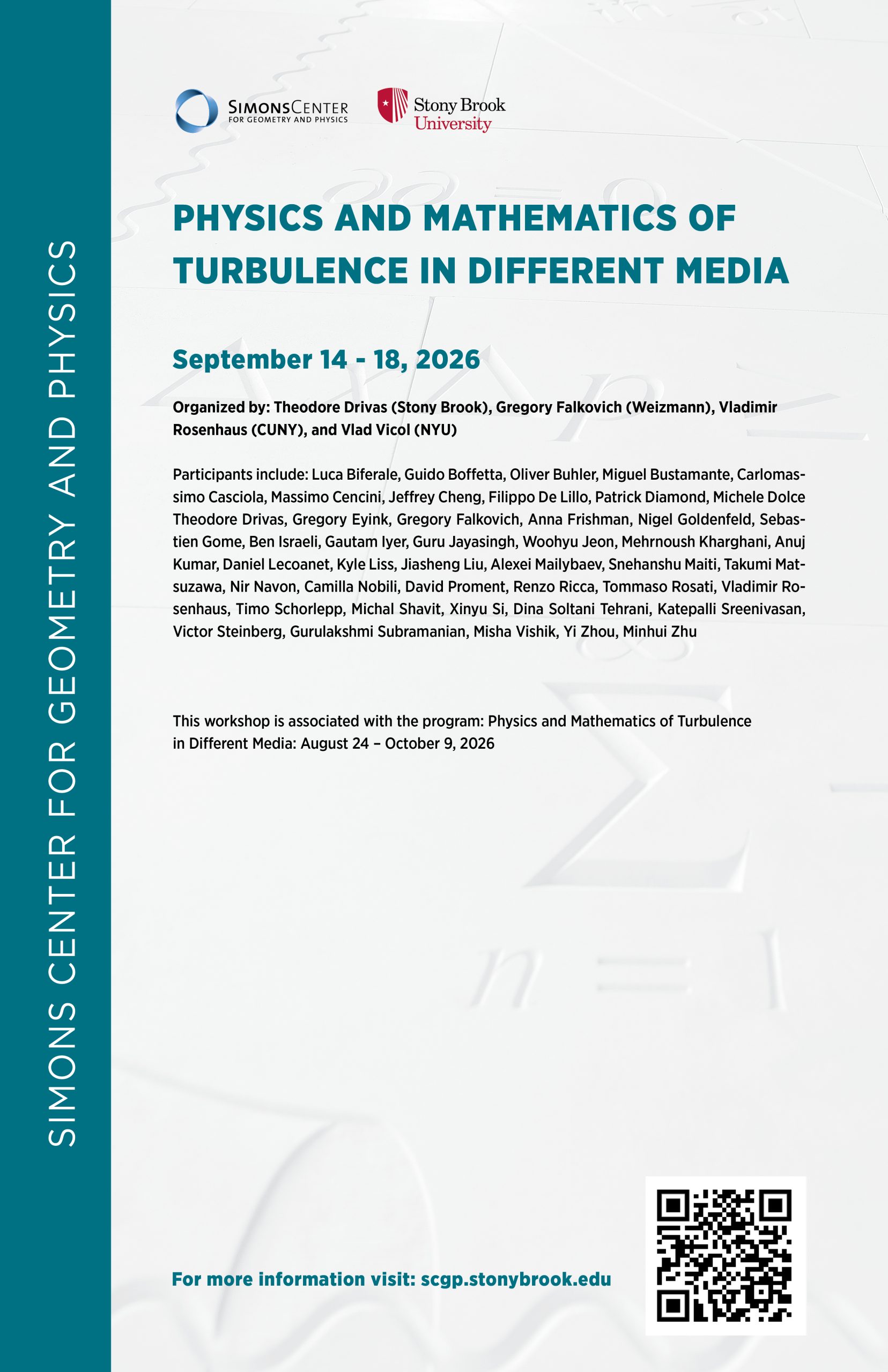
Organized by:
Theodore Drivas (Stony Brook)
Gregory Falkovich (Weizmann)
Vladimir Rosenhaus (CUNY)
Vlad Vicol (NYU)
The last decade has seen significant progress in the studies of turbulence, understood widely as a far-from-equilibrium state of a system with many degrees of freedom. This is due, in particular, to the two just-finished Simons collaborations, one on wave turbulence and another on the statistical physics approach to fluid turbulence. A rich set of physical results, both experimental and theoretical, has been obtained along with fast progress in mathematical methods and rigorous results. While there is no lack in conferences and workshops on different aspects of turbulence, it is high time for people from all fields and corners of turbulence research to get together for a longer stay in a more relaxed setting. There are several new things that are worth discussing in a multi-disciplinary context.
Among the new things is the dramatic advance in wave turbulence in three directions. First, there is an abundance of new experimental and numerical data on turbulence in laboratory, geophysical, and astrophysical systems. Second, there is significant progress in rigorous mathematical proofs of the validity domain of wave kinetic equations and weak turbulence theory. Third, there is a long-awaited revival of applying the methods of quantum field theory to wave turbulence, which allows progress from weak to strong turbulence in analytic theory. That also opens new venues for identifying universality classes of wave-turbulence systems. That opens wide possibilities for future progress in analytical description and calls for tight collaboration with experiments (natural and numerical) to test the recent predictions and present new challenges for the theory.
On classical fluid turbulence, there are many new surprising experimental results obtained during the last decade, particularly on boundary layers and pipe flows, which deserve to be properly discussed and internalized by theoretical physicists and mathematicians. Here, too, we may be in for realizing that there could be several classes of high-Reynolds-number incompressible turbulence rather than a single “Kolmogorov turbulence.”
On the mathematical side, there has been a good deal of progress recently in understanding the formation of singularities, and the non-uniqueness of weak solutions. For instance, it is now known that classical solutions of the Euler equation can form a singularity in finite time, and that weak solutions of forced Euler with unbounded but p-integrable vorticity may be non-unique. This later result holds also for Leray weak solutions of Navier-Stokes equation. Physically, these non-uniquness results shed light on Eulerian spontaneous stochasticity in fluid systems. In addition, there has been much activity in understanding anomalous dissipation/diffusion in “turbulent” toy models, such as passive scalar advection. Non-smooth and multiscale constructions resembling inertial range dynamics give a new, constructive perspective on Lagrangian spontaneous stochasticity and its implications for scalar turbulence.
In formal quantum field theory, there has been growing recognition of the importance of studying richer sets of field theories, such as those lacking Lorentz invariance, as well as states in field theory that are far from the vacuum, such as e.g. the large charge expansion. In more applied quantum field theory contexts, the past decade has seen significant activity— both in condensed matter and high energy theory communities — in studying quantum field theory in states that are far from equilibrium. Notably, wave turbulence in this context has been studied in QCD, in the aftermath of a hadron collision. Separately, the past two decades have witnessed the study of relativistic fluids, again arising from hadron collisions.
This workshop is associated with the program: Physics and mathematics of turbulence in different media: August 24 – October 9, 2026
Talk Schedule
| Time | Title | Speaker | Location |
| 8:30am | Breakfast | N/A | SCGP Cafe |
| 9:30am | Rigorously Certified Neural-Network Computation of Nonlinear Water Waves at Near-Machine Precision | Michal Shavit | SCGP 102 |
| 10:30am | Break | N/A | SCGP Cafe |
| 11:00am | Nonuniqueness of solutions to the two-dimensional Euler equations with integrable vorticity | Anuj Kumar | SCGP 102 |
| 12:00pm | Lunch | N/A | SCGP Cafe |
| 1:00pm | Scale Locality of Kinetic Energy Transfer in Normal Shocks | Dina Soltani Tehrani | SCGP 102 |
| 2:30pm | Instability of the 2D Taylor-Green vortex | Michele Dolce | SCGP 102 |
| 3:30pm | Tea | N/A | SCGP Cafe |
| 4:00pm | Lyapunov exponents for linear cocycles driven by stochastic Navier-Stokes | Tommaso Rosati | SCGP 102 |
| Time | Title | Speaker | Location |
| 8:30am | Breakfast | N/A | SCGP Cafe |
| 9:30am | Enhanced Dissipation and Mixing | Gautam Iyer | SCGP 102 |
| 10:30am | Break | N/A | SCGP Cafe |
| 11:00am | Nonlinear diffusion and decay of a turbulent blob | Takumi Matsuzawa | SCGP 102 |
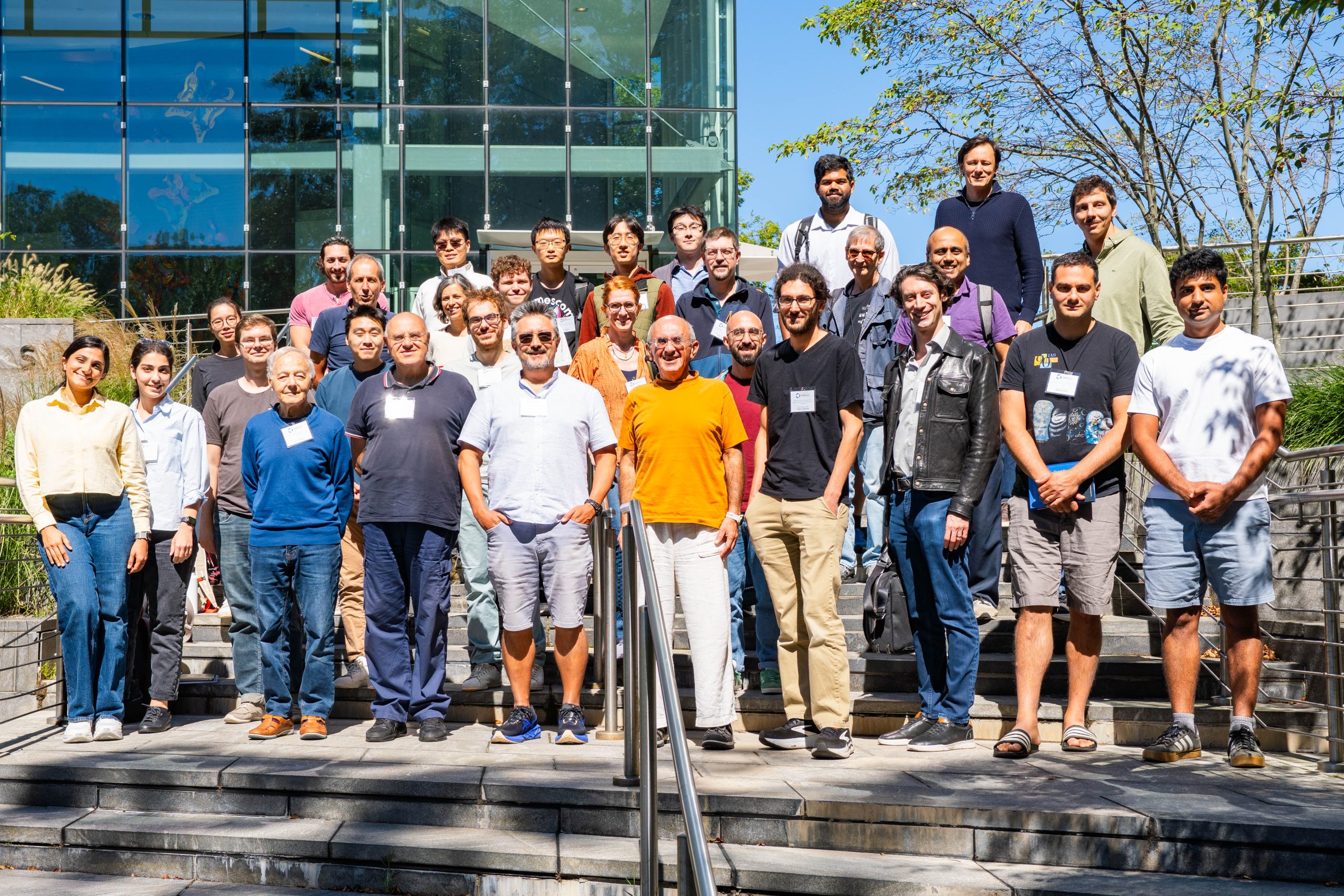
| 12:00pm | Group Photo | N/A | SCGP Lobby |
| 12:05pm | Lunch | N/A | SCGP Cafe |
| 1:00pm | From Boundary Layers to Ultimate Scaling: Covariance Design and Transport Bounds in Thermal Convection | Camilla Nobili | SCGP 102 |
| 2:30pm | The Batchelor spectrum for a passive scalar driven by deterministic forcing | Kyle Liss | SCGP 102 |
| 3:30pm | Tea | N/A | SCGP Cafe |
| Time | Title | Speaker | Location |
| 8:30am | Breakfast | N/A | SCGP Cafe |
| 9:30am | Cascade transitions in Geophysical flows | Alexandros Alexakis | Zoom |
| 10:30am | Break | N/A | SCGP Cafe |
| 11:00am | A Topological Approach to Turbulence Cascade | Renzo Ricca | SCGP 102 |
| 12:00pm | Lunch | N/A | SCGP Cafe |
| 1:00pm | Elastically driven turbulence in low-inertia polymer solution flow | Victor Steinberg | SCGP 102 |
| 2:30pm | Closing the loop: bi-directional fluxes and large-scale two-dimensional flows in rotating turbulence | Anna Frishman | SCGP 102 |
| 3:30pm | Tea | N/A | SCGP Cafe |
| 4:00pm | Instanton calculus for turbulence: recent developments | Timo Schorlepp | SCGP 102 |
| 5:00pm | Discussion of the Millennium Problem | N/A | SCGP 102 |
| Time | Title | Speaker | Location |
| 8:30am | Breakfast | N/A | SCGP Cafe |
| 9:30am | Breaking and emergence of universality in spin wave turbulence | Jiasheng Liu | SCGP 102 |
| 10:30am | Break | N/A | SCGP Cafe |
| 11:00am | Butterfly effect and predictability in turbulence | Guido Boffetta | SCGP 102 |
| 12:00pm | Lunch | N/A | SCGP Cafe |
| 1:00pm | Core-bound waves on a Gross-Pitaveskii vortex | Nir Navon | SCGP 102 |
| 2:30pm | Perturbative anomalous exponents from Kolmogorov multipliers | Alexei Maliybaev | SCGP 102 |
| 3:30pm | Tea | N/A | SCGP Cafe |
| 4:00pm | Stochastic theory for laminar-turbulence transition, pattern formation and front propagation in pipe flow | Nigel Goldenfeld | SCGP 102 |
| 6:00pm | Workshop Banquet | N/A | SCGP Cafe |
| Time | Title | Speaker | Location |
| 8:30am | Breakfast | N/A | SCGP Cafe |
| 9:30am | Data-driven Modeling of Eulerian and Lagrangian Turbulence | Luca Biferale | SCGP 102 |
| 10:30am | Break | N/A | SCGP Cafe |
| 11:00am | Laminar-turbulent transition in pipes with body forces: continuous, discontinuous or both? | Guru Jayasingh | SCGP 102 |
| 12:00pm | Lunch | N/A | SCGP Cafe |
| 1:00pm | Internal Waves in Turbulent Convective / Stably-Stratified Systems | Daniel Lecoanet | Zoom |
| 2:30pm | Eulerian–Lagrangian Relations in Decaying Two-Dimensional Navier–Stokes Turbulence | Snehanshu Maiti | SCGP 102 |
| 3:30pm | Tea | N/A | SCGP Cafe |
| 4:00pm | Triad phase dynamics determine cascade direction in two-dimensional turbulence | Miguel Bustamante | SCGP 102 |